
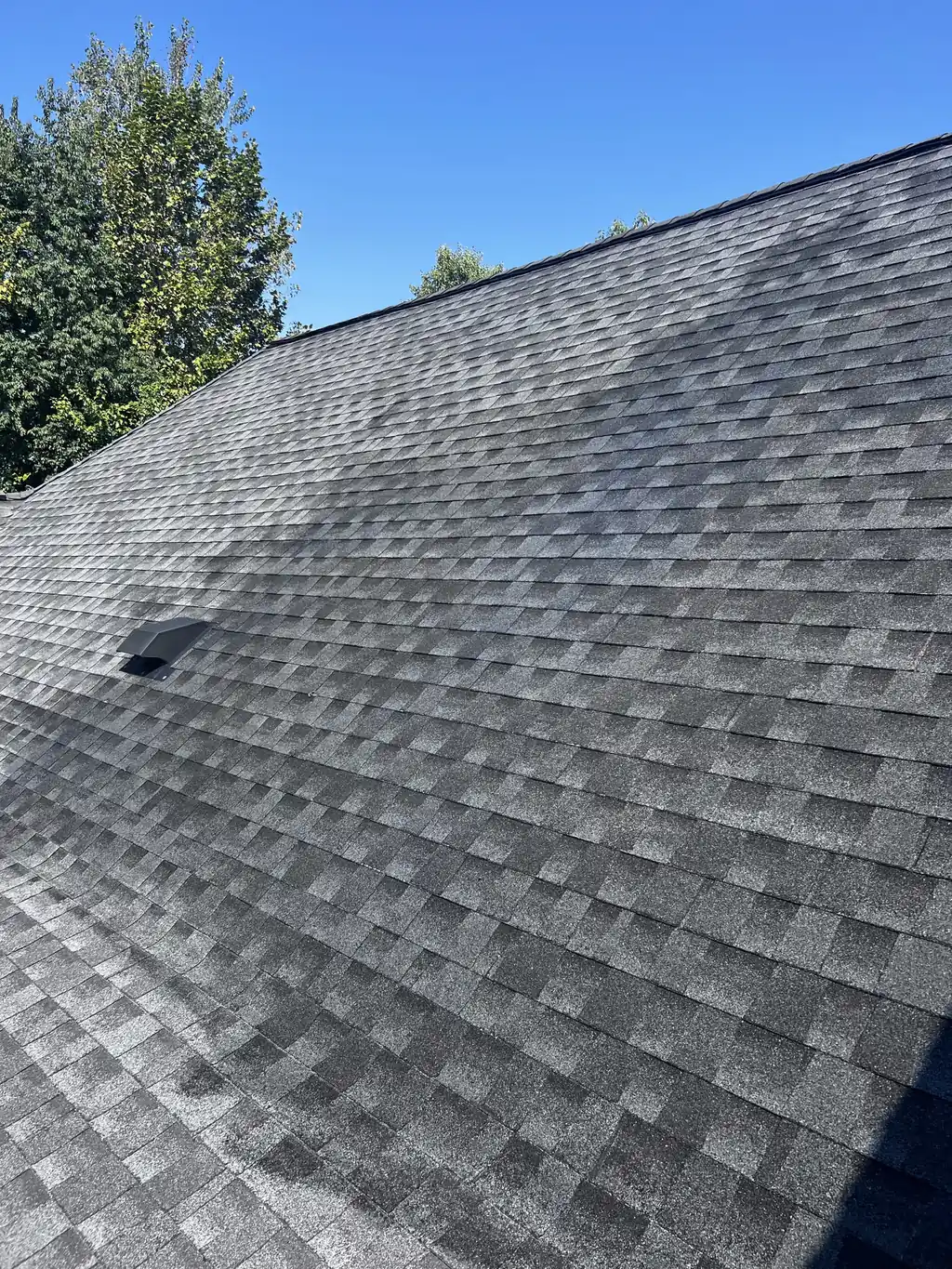
You clean the gutters in the fall and find dark grit at the bottom. That’s granules, the tiny stones pressed into the top of every asphalt shingle. Some is normal. A lot is worth paying attention to.
Shingles don’t give out all at once. Sun, heat, water and cold each take a little every year. Here’s how each one works, using Evansville’s own weather numbers.
How a shingle holds together
An asphalt shingle is asphalt with a coat of mineral granules on top. The asphalt keeps water out. The granules shade the asphalt. InterNACHI says reflecting sunlight “helps protect the asphalt from the damaging ultraviolet or UV radiation in sunlight” (InterNACHI).
The two need each other. Lose granules and more sun reaches the asphalt. And as a shingle ages, InterNACHI says, “the bond between the granules and asphalt deteriorates, and granules will be loosened and carried away by runoff” (InterNACHI on granule loss).
Heat drives off what keeps shingles flexible
InterNACHI uses the word volatiles for the parts of the asphalt that keep it supple. Heat speeds their loss. In InterNACHI’s words, “Keeping the roof cool will help slow the loss of volatiles which keep shingles flexible, durable and waterproof.”
Fewer volatiles means a shingle that’s less flexible, less durable and less waterproof. That’s the dry, brittle roof people describe.
Evansville doesn’t make it easy to keep a roof cool. The July average high is 88.6°F (NOAA monthly normals), and the airport averages 41 days a year at 90°F or above (NOAA annual normals).
Heat from the attic side
InterNACHI’s point is about keeping the roof cool, and a hot, stuffy attic works against that from underneath. If yours turns into an oven in July, ask a roofer to check the ventilation. That’s a building fix. No treatment replaces it.
Rain carries the granules away
How fast a roof sheds granules, InterNACHI says, “depends on the quality of the shingles and the climate zone of the home.” Evansville’s climate keeps the runoff coming. The area averages 47.91 inches of precipitation a year, with measurable rain or snow on 118 days (NOAA). April and May are the wettest months, at a little over 5 inches each. Every storm sends some grit down the downspouts.
Patchy loss is a different story from even wear. Storms can knock granules loose in one area. InterNACHI notes that “with older roofs, even marble-size hail may loosen granules.” The wrong cleaning can do it too, which we get to below.
Freeze and thaw, over and over
Cold brings its own stress. Evansville gets 90.4 nights a year at or below freezing. Yet only 15.7 days a year stay below freezing from morning to night. Do the math on those NOAA normals and you get about 75 days a year when a roof freezes overnight and thaws by afternoon.
Water grows when it turns to ice. Once a shingle has small cracks, or bare spots where granules used to be, water has somewhere to sit. Then it freezes, expands and thaws again. It’s the same freeze-thaw stress that makes concrete flake, and Evansville serves up plenty of it.
Algae and the black streaks
Black streaks aren’t the shingle drying out. They’re algae, not dirt, and algae likes a roof that stays damp. Evansville’s air helps it along. Mean relative humidity here is 70.2%, peaking in December and September (NOAA 1961-1990 figures).
We haven’t found a source we’d trust that says algae dries shingles out faster. The bigger risk is how it gets cleaned off. That bond is why we never put a pressure washer, brush or broom on shingles. More on what causes black streaks on a roof.
Signs you can spot from the ground
- Dark grit in the gutters or at the bottom of the downspouts.
- Color that’s faded or uneven, with some patches lighter than others.
- Shingle edges curling up or cupping.
- Cracked tabs, or shingles gone after a windy night.
- Black streaks running down a slope.
Even grit and even fading line up with what InterNACHI calls normal weathering. Curling, cracks and missing shingles are worth a closer look.
What you can do about it
No roof stops aging. But you have choices about what happens next.
- Check the gutters each fall. More grit than last year is worth a photo.
- Get black streaks cleaned with a low-pressure soft wash, never a pressure washer.
- For a roof in fair shape, roof protection is a treatment designed to help shield roofing from moisture and UV.
- For shingles that are drying out but still sound, roof rejuvenation is meant to help restore flexibility.
Neither treatment is a given. Before we suggest one, we look up your shingle maker’s guidance, and your HOA’s rules if you’re in one. Some roofs only need cleaning. Some need a roofer. The free exterior evaluation sorts out which. Call or text Terrance at (812) 664-6222.
Common questions
Is it normal to find granules in my gutters?
Some, yes. InterNACHI says granule loss that’s even across a roof is usually normal weathering. What matters is how much and where it comes from. A little grit at every downspout is wear. Bare patches on one slope, or a big jump in grit right after a storm, is worth having someone look at. Snap a photo of what you find.
Does algae make shingles dry out faster?
We haven’t found a source we trust that says so. The bigger risk is cleaning the streaks the wrong way. We never put a power washer, brush or broom on shingles. We stick to a low-pressure soft wash. And cleaning isn’t a one-time fix. Algae can grow back over time, so the streaks can return.
Can brittle shingles be made flexible again?
Sometimes, on the right roof. Rejuvenation is meant to help restore flexibility in aging asphalt shingles that are still sound. It can’t fix cracked tabs, curling or bare mat. Before we recommend it, we check your shingle maker’s guidance and any HOA rules. The evaluation then tells you whether your roof is a candidate at all.