It starts small. A rough patch by the garage door, right where the car drips salty slush all winter. Then the edge of the front steps starts to flake.
Here’s the short answer. If your concrete is still sound, protecting it sooner beats waiting. Protection can’t undo damage that’s already there. It can only help the surface you still have. Here’s why, with Evansville’s winter numbers.
What winter does to bare concrete
Concrete is full of tiny pores, and they soak up water. The National Ready Mixed Concrete Association (NRMCA) explains what happens next: “When concrete is saturated with water and temperature approaches freezing, water expands as it forms ice and this causes stresses within concrete. As the number of cycles of freezing and thawing increases, the potential for scaling increases” (NRMCA, Concrete in Practice 2). Scaling is the flaking and peeling you see on top.
Evansville serves up a lot of those cycles. The airport averages 90.4 nights a year at or below 32°F, and only 15.7 days when the high stays at or below freezing. That leaves about 75 days a year that freeze at night and thaw by day, by our arithmetic on NOAA’s 1991-2020 normals. Add 47.91 inches of precipitation a year, and there’s no shortage of water to soak in.
Salt makes it worse
NRMCA says deicing chemicals make scaling worse “by increasing the saturation of concrete at the surface and the number of freezing and thawing cycles.” So the salt that keeps your steps from icing over also keeps the surface wetter, and cycling more often.
What protection can do
Protection goes after the first part of NRMCA’s problem: water soaking in. NRMCA recommends a breathable sealer or water repellent made for concrete slabs, and it names silane and siloxane products. NexaNano, who makes the treatment we use, describes its products as SiO2 (silicon dioxide) treatments. For concrete, it calls its product “a transparent, deep-penetrating treatment designed for all concrete surfaces” (NexaNano).
In plain terms, it helps the slab shed water and salt instead of soaking them up. Purdue University’s research for the Indiana Department of Transportation backs the basic idea. It found “absorption testing was able to show the benefits of sealers” (Purdue JTRP report).
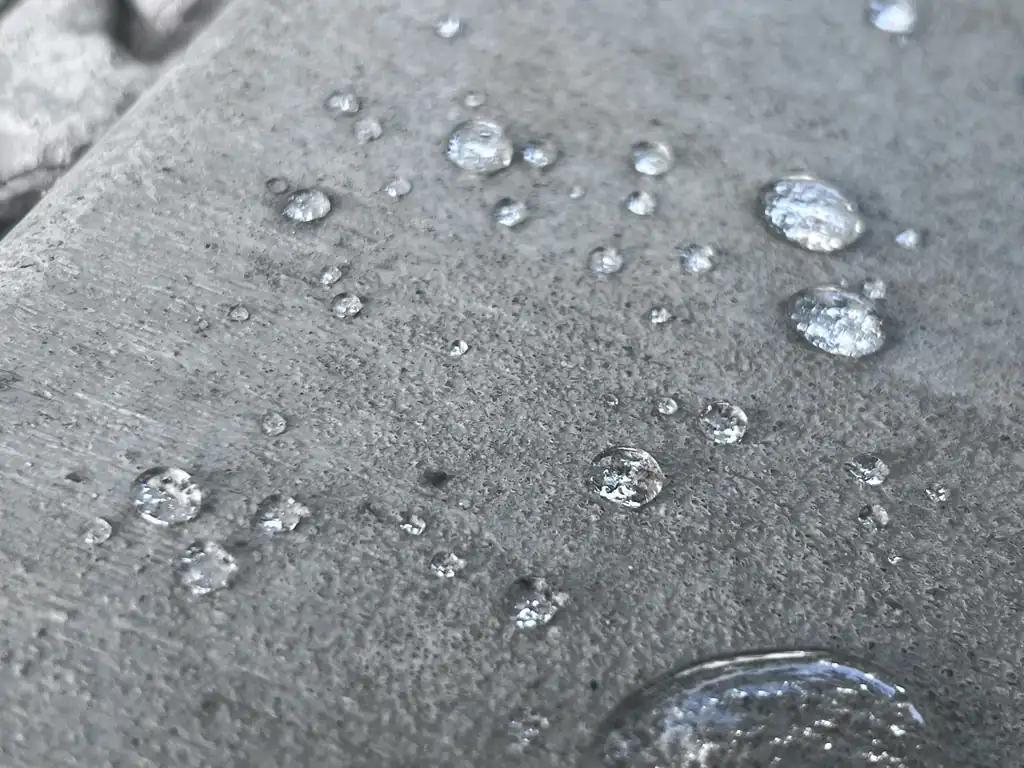
After we apply it, we check the surface with a water-beading test. Water should bead on top instead of soaking in. NexaNano’s product FAQ covers how the treatment looks once dry and how long it takes to cure, and we sum both up in the questions below.
What protection can’t do
- It won’t close cracks that are already there.
- It won’t level a slab that has sunk or heaved.
- It won’t rebuild a surface that has already scaled.
- It isn’t a promise that the slab will never crack.
That last one deserves a straight answer. The same Purdue study found that “differences were observed regarding the influence of sealer composition on freeze-thaw damage.” Results varied with the product. It also found that once concrete hit a critical level of saturation, “freeze-thaw damage was inevitable.” Protection is meant to help keep water out of the slab so it stays further from that point. It can’t make concrete crack-proof.
The cost of waiting, in plain terms
Every winter you wait gives bare concrete another round of freeze-thaw days, plus whatever salt rides in on the tires. NRMCA’s point is that the risk grows with every cycle. Then one spring the top layer starts to go.
Once the surface has scaled, no treatment puts it back. From there, the fix is a bigger job for a concrete contractor, and that’s not work we do. So waiting doesn’t keep your options open. It moves you from a protection job to a contractor job.
When it’s too late for protection to help
- Scaling across most of the surface, with stone showing everywhere.
- Wide cracks, or edges breaking off.
- Slabs that have sunk or tilted.
- Spots that crumble when you scrape them.
If we see that, we’ll tell you plainly and point you to a concrete contractor. A small rough patch by the garage is a different story. That’s the moment to look at the rest of the slab, before more of it goes. Read why concrete flakes or pits for more on what’s already happening.
When to do it
NRMCA says the concrete “should be reasonably dry prior to the application of a sealer,” and adds, “Late summer with a few dry days preceding application is an ideal time.” In Evansville, the median first fall freeze comes around October 29, and the median last spring freeze around April 4 (NOAA freeze dates). Miss late summer and it comes down to the forecast and how dry the slab is. We’ll tell you if spring makes more sense.
Clean comes first either way. NexaNano’s process strips off dirt, grease, mildew and failing coatings, then lets the surface dry fully before the treatment is sprayed on evenly (NexaNano on concrete prep). That’s why concrete cleaning is step one.
This winter, either way
- If you use a deicer, pick rock salt (sodium chloride) or calcium chloride. NRMCA considers both acceptable for concrete.
- Never use ammonium sulfate, ammonium nitrate or magnesium-based salts as a deicer.
- Keep deicer off new concrete if you can, and use clean sand for traction instead.
- When the weather allows, hose off the salt your car drags onto the driveway and garage floor. NRMCA recommends that too.
What happens next
If your slab is still sound, our concrete protection page covers the treatment. If you’re not sure which side of the line you’re on, the free exterior evaluation will tell you. We look at the driveway, walks, patio and steps and give you a plain answer. Call or text Terrance at (812) 664-6222, Monday to Saturday.
Common questions
Will concrete protection stop my driveway from cracking?
We won’t promise that. Protection helps reduce how much water and salt soak into the surface. Purdue’s research for the Indiana Department of Transportation found sealer results on freeze-thaw damage varied with the sealer. And a surface treatment can’t do anything about a slab that settles or shifts. What it can do is help the surface you have shed water.
Does concrete protection make the surface slippery?
NexaNano, who makes the treatment we use, says its products dry clear, don’t leave a shiny film, won’t yellow and don’t make surfaces slippery. Wet or icy concrete is still slippery, treated or not. Keep using sand or an acceptable deicer when it freezes.
How soon can we walk or drive on it after treatment?
NexaNano says most treated surfaces are dry to the touch within one to two hours, depending on temperature and humidity, and fully cured within 24 to 48 hours. We’ll tell you on the day when it’s fine to walk on it and when to bring the car back, based on the weather.