Newburgh is really two places. There’s the old river town on the bluff, with painted brick buildings downtown. And there’s the newer Newburgh that grew up around it, the subdivisions most people mean when they give a Newburgh address.
In fact, most Newburgh mailing addresses sit outside the town limits, in Ohio Township, Warrick County. Inside the town limits, the median home was built in 1976, 14% were built in 1939 or earlier, and 23% went up in 2000 or later. The median home value there is the highest of the six towns we serve. Those figures come from the Census Bureau’s 2020 to 2024 American Community Survey. Across all of Warrick County, the median build year is 1986.
Brick on the bluff
The Original Newburgh Historic District went on the National Register in 1983. It covers about four square blocks, roughly bounded by State Road 662 and Water, Monroe, Main and Middle streets. The nomination says the town sits “on a high bluff on the river” and counts some forty-four substantial buildings, most of them brick. The Exchange Hotel, used in the Confederate raid of July 18, 1862, still stands. And the Rivertown Trail runs through downtown along the Ohio River, from Angel Mounds State Historic Site to Locks and Dam Park.
That same 1983 nomination says something every owner down there should know. The brick was traditionally painted, which was “customary with the use of the soft bricks.” It also flagged “a handful of recent but worrisome sandblastings” (National Park Service nomination).
House washing that respects soft brick
Soft brick and high pressure don’t mix. The Brick Industry Association says not to go above 400 psi at the nozzle unless the brick maker allows it, to hold the fan tip at least 12 inches from the wall, and to test a 20 square foot sample area first. It also lists historic significance as a reason to take extra care (BIA Technical Note 20).
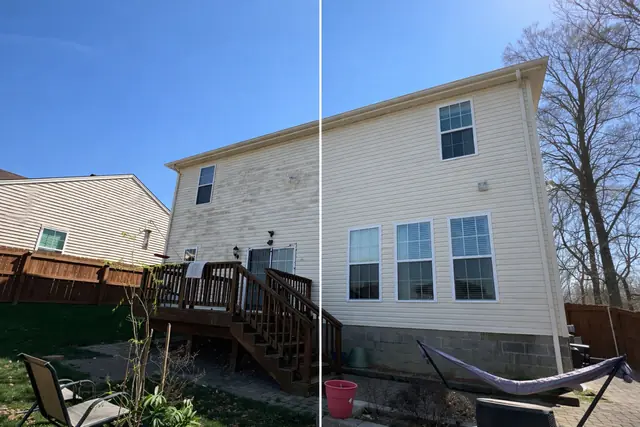
Our house washing is low pressure, and on older brick we go by that guidance. We also look at the paint before we wash a whole wall. For siding, soffits and gutter faces in the newer neighborhoods, it’s the same gentle approach.
Roofs across the subdivisions
Newburgh grew in the boom of the 1960s and 1970s, when it became a bedroom community for families who wanted new housing near Evansville. Then Ohio Township kept building. That adds up to a lot of asphalt roofs of very different ages.
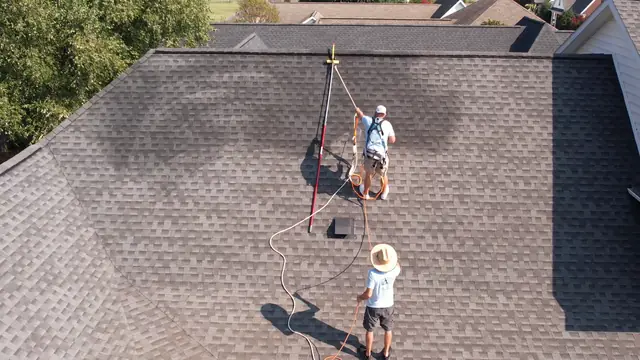
If yours is drying out and fading but still sound, roof rejuvenation may be worth a look. If it leaks or the decking is soft, it isn’t, and we’ll tell you to call a roofer. Before we recommend any treatment, we check your shingle brand’s guidance. If your subdivision has an HOA, we check its rules as well.
Driveways and walks in Warrick County
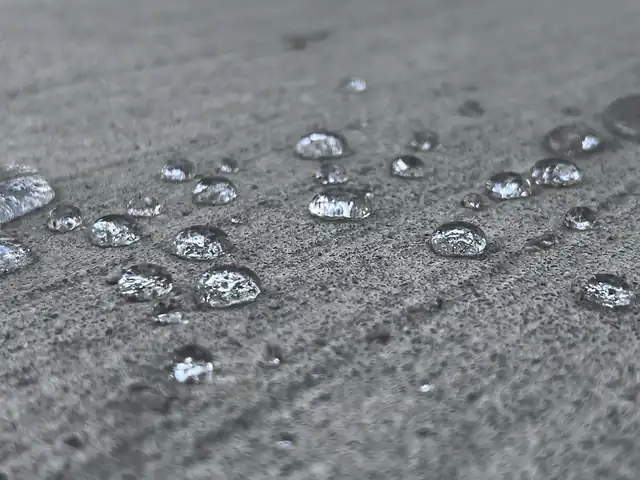
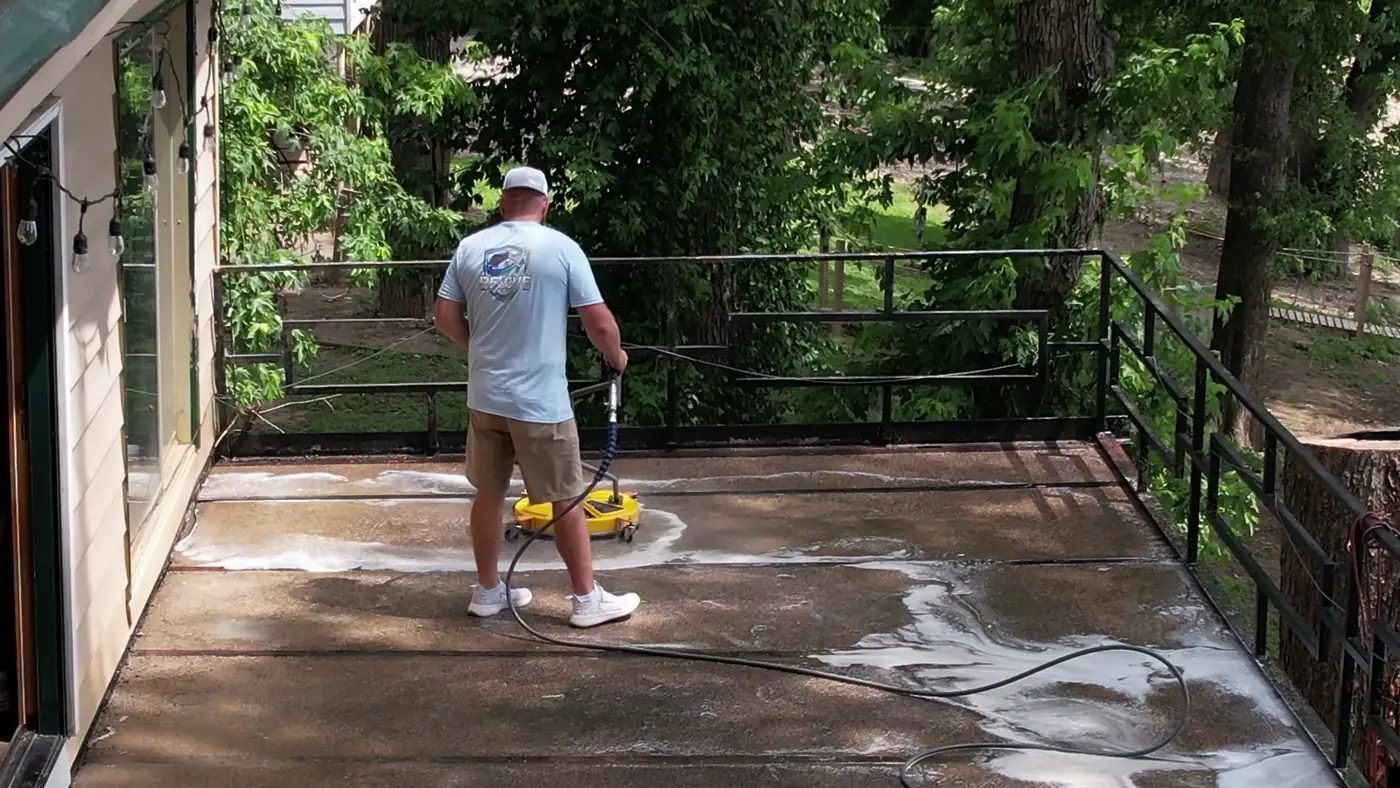
Newer neighborhoods come with newer concrete. Long driveways, sidewalks, patios, pool decks. Concrete protection helps cut down how much water and road salt soak into the surface. It won’t stop cracks.
Timing matters. The National Ready Mixed Concrete Association says the concrete should be reasonably dry first, and that “late summer with a few dry days preceding application is an ideal time” (NRMCA). We’ll tell you if your slab is clean enough and dry enough to treat.
Storms on the north and northeast side
On November 6, 2005, the F3 tornado that killed 25 people across the region came through here. NWS Paducah wrote that “from the north side of Newburgh to DeGonia Springs, houses were severely damaged or destroyed.” On May 14, 2024, a brief EF-1 with peak winds of 94 mph struck the northeast side of Newburgh, and large limbs came down at Sharon Road and Kenwood Drive.
Wind damage is roofer work, not ours. What we can give you is a clear set of photos, so you know where your roof stands.
What happens next
Book a free exterior evaluation. Newburgh is about 12.9 miles and 20 minutes from our base on Broadway Ave, so it’s an easy trip for us. Call or text Terrance at (812) 664-6222. We also work up the road in Boonville and back west in Evansville.