You notice it from below. The skylight over the kitchen lets in less light than it used to. There’s a white splat on the solar panels by the chimney, and it’s been there since spring.
Glass that faces the sky catches whatever falls on it. Pollen, dust, leaves, seeds and bird droppings. Rain rinses some of it off. Not all of it.
We clean skylights, solar panels and other rooftop glass with water, a mild cleaner and soft tools. Never a pressure washer. Not sure yours need it? Start with a free exterior evaluation.
Solar panels: the maker’s manual comes first
NREL, a U.S. Department of Energy lab, put out a best practices guide for solar maintenance in 2018. Its cleaning advice opens plainly: “Follow the PV module manufacturer’s recommendations with any array cleaning.”
The guide calls for plain demineralized water and a mild detergent the panel maker recommends. It says not to use “high-pressure water, brushes, or any types of solvents, abrasives, or harsh detergents.”
Panel manuals don’t all say the same thing about tools. That’s why we look up the make of your panels and read the cleaning section before we pick a tool. If the manual says water only, it’s water only.
Pure water on a long pole
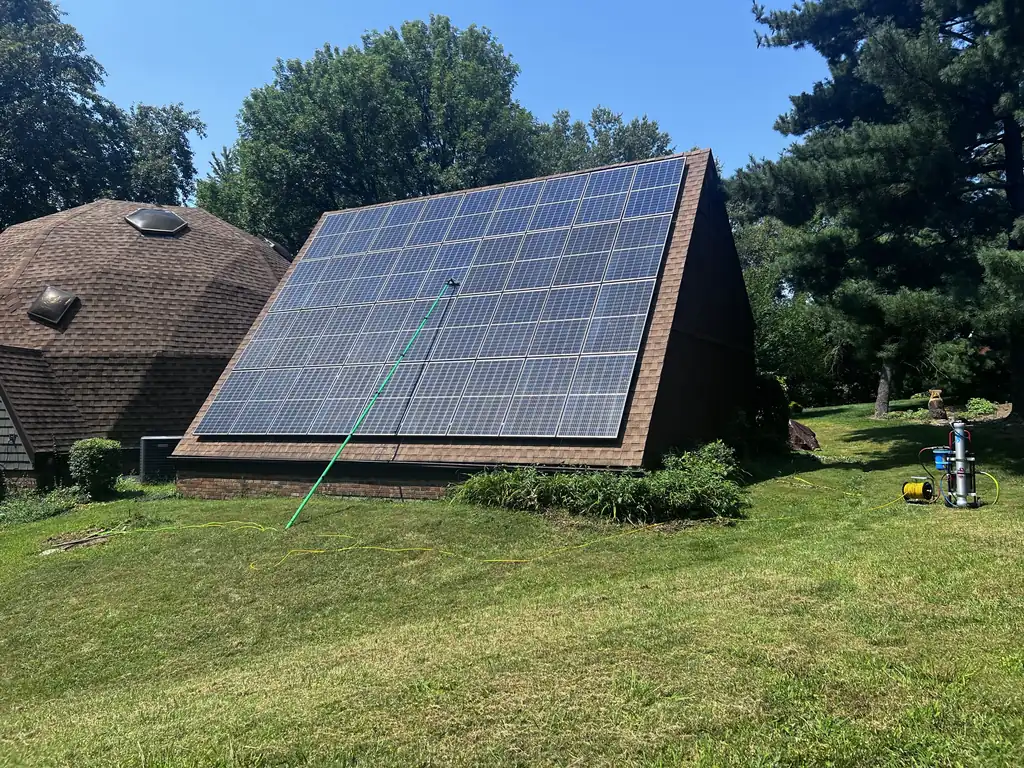
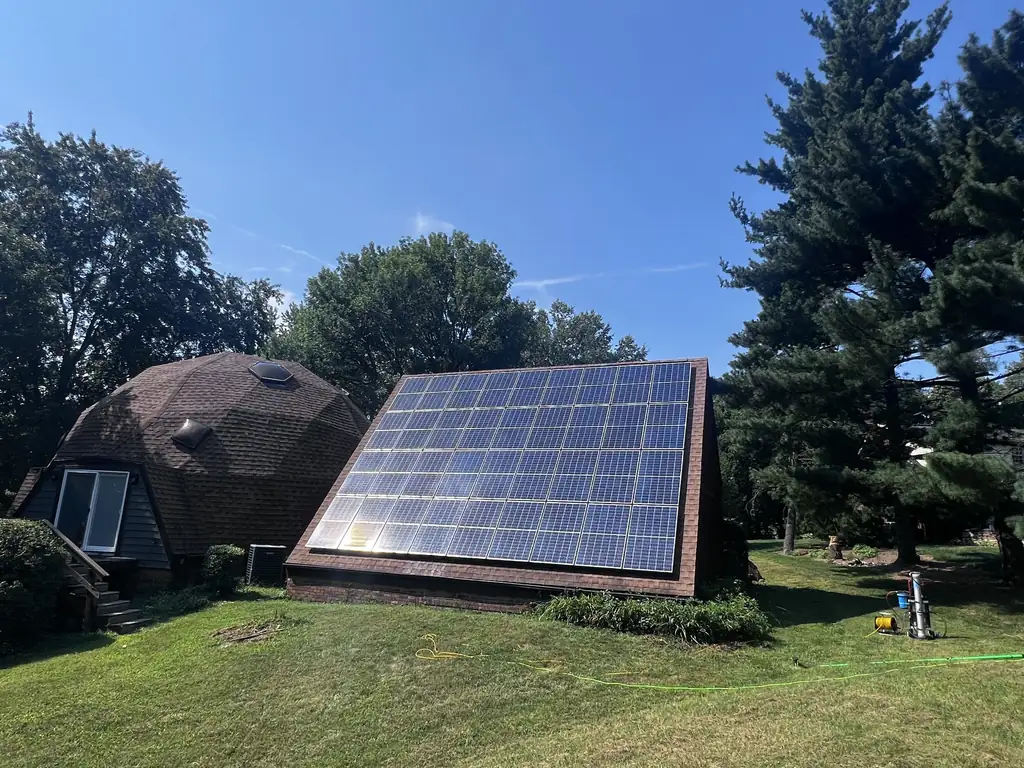
On ground arrays and low roofs, we can often work from below with a water-fed pole. It’s a long pole that carries filtered water up to a soft head. The pole head is a brush, so we only use it where your panel maker allows a soft brush. Filtered water has the minerals taken out, which fits NREL’s call for demineralized water.
Why ground arrays get dirty faster
NREL’s guide says cleaning needs go up for ground-mounted arrays “because they are closer to the source of airborne dirt and pollen.” A rack of panels in the yard sits right down in the dust and the pollen.
The guide also points at birds. It says efforts should be taken to reduce uneven soiling, “for example, from bird droppings.” For pollen, its advice is to schedule cleaning “after the end of pollen season.” We’ll usually suggest the same timing.
Skylights
VELUX, a skylight maker, says its skylights are low maintenance but “should still be periodically cleaned on the exterior.” Its skylight cleaning tips say window cleaners can usually reach them with telescoping brushes and squeegees “without needing to get on the roof.”
That’s our first choice too. We’d rather keep foot traffic off your shingles. When a skylight can only be reached from the roof, we go up carefully, step only where we have to, and never stand or kneel on glass or panels.
Around the frame
VELUX also says to clean around the skylight where the flashing is installed “so rainwater will continue to flow freely.” Leaves and seeds can pile up on the uphill side. We clear that out while we’re up there.
For inside glass, VELUX says to use soft water or a nonabrasive cleaner with a soft, lint-free cloth, and to skip abrasive products. If you want the inside done and we can reach it, that’s how we do it.
What a cleaning won’t do
We won’t promise more power after a cleaning. NREL’s guide says the benefits of cleaning “may be hard to calculate.” You get glass without the droppings and pollen film, and photos of anything odd we spot.
- Cracked panel glass or a cracked skylight. We’ll photograph it and stop. That’s for your solar installer or a roofer.
- Wiring, connectors and the inverter. We don’t touch the electrical side. Problems there go to your solar installer.
- Streaks between skylight panes. VELUX says condensation that stays between the panes after cleaning “could be a sign of sealant failure.” That’s a replacement question, not a cleaning one.
You probably don’t need this if…
- Your panels only have light dust. NREL’s guide notes that a heavy rain can “clean the array for free.”
- Your solar company’s service plan already covers cleaning. Check that first.
- Snow is the problem. We don’t clear snow off panels.
- The roof itself is green or streaked with black. That’s a roof cleaning job, done with a low-pressure soft wash, and it’s planned on its own.
- The skylight leaks. Cleaning won’t stop a leak. Call a roofer.
What happens next
Book a free exterior evaluation. We’ll look at the skylights and panels from the ground, find the panel make if we can, and tell you how we’d reach them. If you have the panel manual or your installer’s paperwork, keep it handy.
Or call or text Terrance at (812) 664-6222, Monday to Saturday, 9am to 5pm. We also clean windows inside and out and glass doors, railings and mirrors, so the rest of your glass can get done on the same trip.
Common questions
Will clean panels make more power?
We don’t promise that. NREL’s maintenance guide says the benefits of cleaning can be hard to pin down, and a good rain sometimes does the job for you. If your system has an app that tracks output, you can compare before and after yourself. We’d rather you judge it with your own numbers than take our word for it.
Do you walk on solar panels?
No. We clean from the ground, a ladder, or the roof beside the panels, and we never stand, kneel or lean on them. Where a long pole can reach, we use it. If panels can’t be reached without stepping on them, we’ll tell you and leave them for your solar installer.
Can you clear snow off my panels?
No. NREL’s guide says snow removal from panels is generally not recommended because it may damage them. It also notes that snow generally slides off steeper panels on its own. Evansville averages 10.8 inches of snow a year (NOAA 1991 to 2020 normals). If heavy snow on your roof worries you, call your solar installer.