
You bought a pressure washer for the driveway. Now the north wall looks green, the roof has black streaks, and you’re wondering how far that wand can go.
Not far, for most of the house. Each surface has a limit, and the trade groups behind some of those materials have written theirs down. Here’s what they say, and how we clean each one.
Two different tools
A pressure washer blasts dirt off with force. That’s what you want on hard, flat concrete. Roofing needs a different approach.
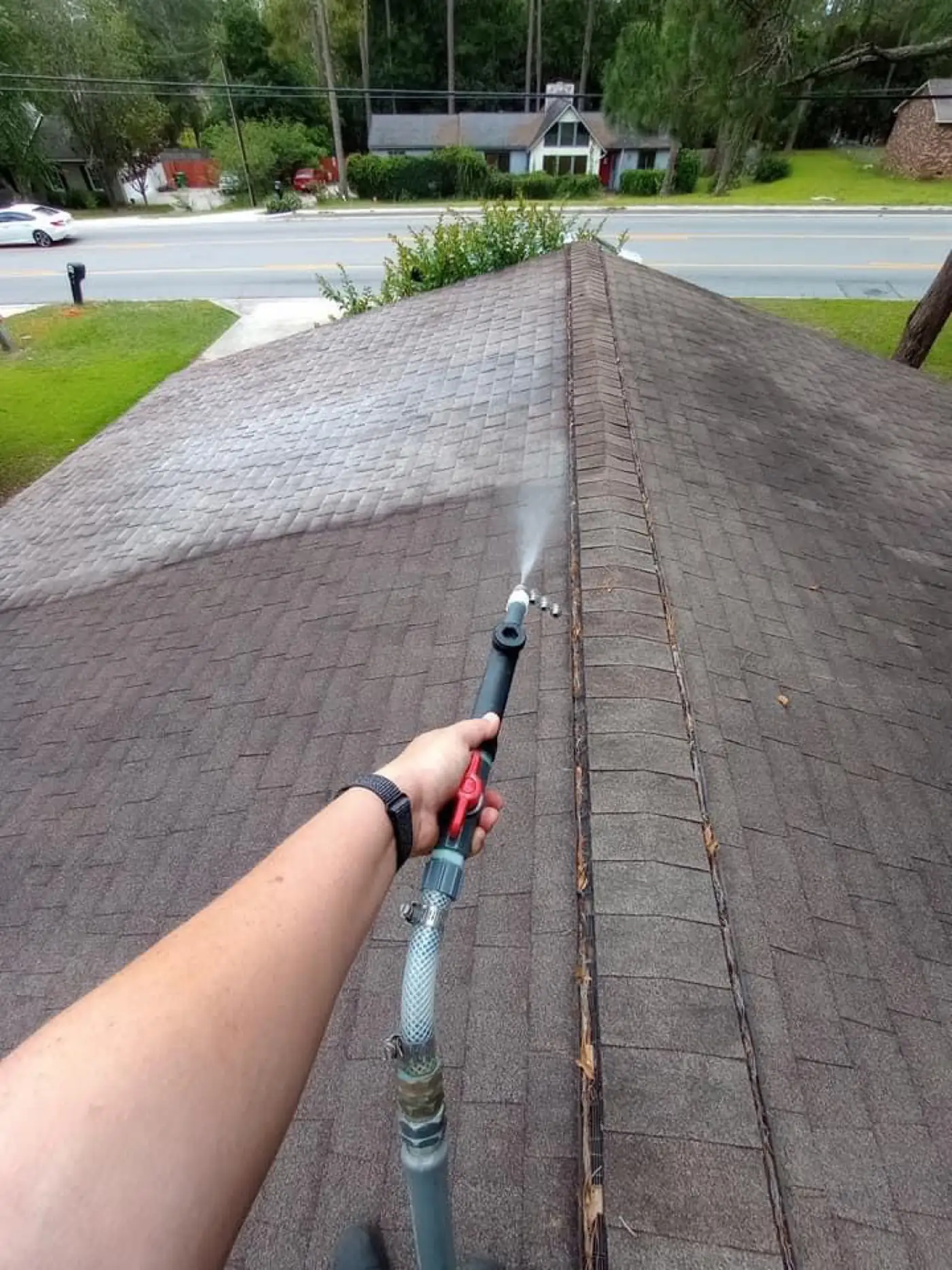
Soft washing uses low pressure and a cleaning solution. The solution does the work, then a gentle rinse carries it away. No blasting and no scrubbing.
The gap between the two tools matters most on surfaces that are layered, porous or old. That covers most of a house.
Surface by surface
Here is the short version. The sections below give the detail and the sources.
| Surface | What the source says | How we clean it |
|---|---|---|
| Asphalt shingle roof | InterNACHI: the granules come loose from the asphalt as a roof weathers. | Low-pressure soft wash. Never a pressure washer. |
| Vinyl siding | Siding trade group: a garden hose and mild soap for routine cleaning. A power washer only with caution, aimed level. | Soft wash at low pressure. |
| Brick | Brick Industry Association: ask the brick maker first. No more than 400 psi at the nozzle, tip at least 12 inches away. | Low pressure, with a test patch first. |
| Painted wood trim | We found no trade group guidance we would quote. | Low pressure only. |
| Concrete | NexaNano preps concrete for its treatment with pressure or soft-wash equipment. | Surface cleaner on flat work, then a rinse. |
| Pavers | We found no trade group guidance we would quote. Ask the maker or installer. | Test a small area first. |
Roofs: never a pressure washer
This one is our rule, and we don’t bend it. A shingle is asphalt with a coat of mineral granules on top. InterNACHI says that with age, “the bond between the granules and asphalt deteriorates” (InterNACHI on granule loss). So we keep high pressure off the roof entirely. A stiff brush or a broom does the same.
Two more things worth knowing before you hire anyone. A wet roof is slippery, so leave the climbing to people who do it every day. And a clean roof doesn’t stay clean for good. Algae can grow back over time.
We soft wash roofs and never pressure wash them. We look at the roof first and only recommend cleaning when it’s the right call. More on our roof cleaning.
Vinyl siding: low and level
The vinyl siding trade group, now called the Polymeric Exterior Products Association, says siding “only needs mild soap and water from a garden hose for periodic cleaning.” A power washer “can be used, but with caution” (siding care guide).
The caution is about aim. “Do not aim the stream upward, as this can force water behind the siding panels.” The group also notes that “some siding manufacturers do not recommend power washing, while others have limits on the pressure (PSI) and cleaners that can be used.” Undiluted chlorine bleach is on its list of things to avoid.
That’s why our house washing is a soft wash, with the pressure set for each surface.
Brick: ask first, test first
The Brick Industry Association’s Technical Note 20 opens with a rule: “The brick manufacturer should be consulted before use of pressurized water to clean brick” (BIA Technical Note 20). It also sets limits. No more than 400 psi at the nozzle tip unless the brick maker permits it. A 25 to 50 degree fan tip held at least 12 inches from the brick. Pre-wetting at under 100 psi. And a 20 square foot test patch, left to dry before anyone judges the result.
Old brick needs extra care
BIA lists historic significance among the traits that call for extra care, and it warns that sandblasting “has a significant potential to damage masonry.” That’s not theory here. Newburgh’s 1983 historic district nomination describes soft brick that was traditionally painted, and flags “a handful of recent but worrisome sandblastings” (National Park Service). Evansville, Boonville, Mount Vernon and Princeton all have listed historic districts with older brick buildings too.
Concrete: where pressure fits
Concrete is where a pressure washer earns its place. Even NexaNano’s prep for its concrete treatment starts with “pressure washing or soft-washing equipment” to clear off grime, oil stains, mold and old coatings (NexaNano).
We run a surface cleaner over driveways, walks and patios, then rinse. If protection is going on afterward, the clean comes first. More on our concrete cleaning.
Painted trim and pavers
We couldn’t find trade group guidance on these two that we’d quote, so here’s our habit. Painted trim gets low pressure only, the same as the gentlest surface on the house. Pavers get a small test area first, the way BIA asks for on brick. If you know who made or laid your pavers, their care advice comes first.
What happens next
Not sure what each surface on your place can take? That’s part of the free exterior evaluation. We look at the roof, the walls and the flat work, and tell you what each one needs, including when the answer is nothing. Call or text Terrance at (812) 664-6222.
Common questions
Can a pressure washer damage a shingle roof?
It can, and we never take the chance. The granules on a shingle shade the asphalt, and InterNACHI says their bond to the asphalt weakens with age. We don’t want to be the reason any of them come loose, so pressure stays off the roof. Brushes and brooms are out too, for the same reason. That’s why we only soft wash roofs, with low pressure and a cleaning solution, then a gentle rinse.
Will the streaks come back after a soft wash?
They can. Algae can grow back over time, so a soft wash won’t keep a roof clean for good. After cleaning, a protection treatment can be added to help keep the roof clean longer. Before we recommend one, we check your shingle maker’s guidance, and your HOA rules if you have one.
Should I pressure wash my own siding?
You can, carefully. The siding trade group says a garden hose and mild soap handle routine cleaning, and a power washer can be used with caution. Hold it straight at eye level and never aim it upward, or water can get behind the panels. Check your siding maker’s limits first, because some don’t recommend power washing at all.